PM Wong pushes for deeper Asean economic integration as single market
He also notes at DBS forum with the bank’s CEO Tan Su Shan how firms can manage AI’s impact on jobs and...
Source: The Business Times Singapore · October 12, 2026 at 3:32 PM · AI-assisted report
Single-source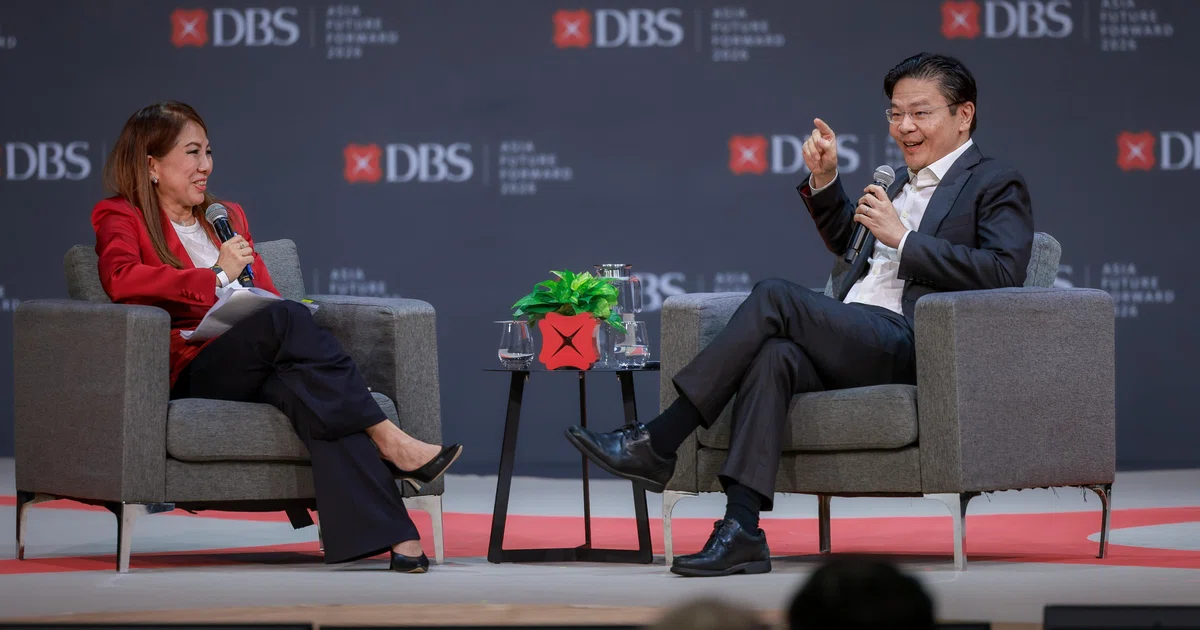
SINGAPORE, 12 OCTOBER 2026 —
Singapore PM Wong Urges Asean to Forge Single Market, Digital Integration as Key to Regional Growth
Prime Minister Lawrence Wong of Singapore has called for Southeast Asia to accelerate the formation of a unified market and deepen digital integration to sustain investment flows and economic growth, warning that fragmentation risks leaving some economies behind as artificial intelligence reshapes industries.
Speaking at the DBS Asia Future Forward Conference in Singapore on Monday, Wong stressed that while the Asean Digital Economy Framework Agreement (DEFA), set for signing in November, marks a critical first step, its success hinges on translating policy into seamless cross-border trade and financial flows—a priority Singapore will champion as it assumes Asean’s chairmanship next year.
The push for a single Asean market comes as regional economies grapple with persistent barriers to trade, investment, and digital connectivity, despite decades of economic cooperation. Wong framed the challenge as stark: Southeast Asia lags even behind Europe in market integration, with businesses citing "different rules, systems, and requirements" across member states as a major obstacle.
"We are like Europe, but in fact, even further behind because the complexity of operating in Southeast Asia is far greater than in Europe," he said, adding that the region’s diversity—cultural, regulatory, and technological—demands a more ambitious approach to harmonization.
At the heart of Wong’s vision is the digital economy, where Asean’s fragmented regulatory landscape currently stifles growth. The DEFA, slated for adoption at the 49th Asean Summit in November, aims to streamline data flows, reduce friction in cross-border payments, and lower costs for businesses scaling across the region.
Wong acknowledged that the agreement alone will not solve these issues but described it as a "first but important step." He cited examples of companies struggling to engage customers or operate efficiently due to inconsistent regulations, emphasizing that Singapore’s chairmanship next year will focus on turning DEFA’s principles into actionable policies. "That’s our ultimate goal," he said, highlighting the need for "less friction and lower costs" in regional commerce.
The prime minister also warned that disparities in AI adoption across Asean could widen economic divides, with some nations leveraging the technology for growth while others lag. "Some are moving more decisively, and they are harnessing AI well, and they are benefiting from the changes. Others are moving more slowly and not benefiting as much," Wong said.
He pointed to Singapore’s strategy of reskilling and upskilling workers as a model for managing AI’s disruptive impact, though he acknowledged that automation will inevitably lead to job losses. "We are not saying zero retrenchments," he said, urging companies to handle transitions responsibly—providing advance notice, facilitating union support, and expanding government-backed retraining programs.
Beyond AI, Wong addressed broader shifts in global supply chains, arguing that the era of hyper-efficiency is giving way to a need for resilience. "You cannot operate on the basis of just-in-time and efficiency all the time," he said.
"You have to have resilience, and that costs something." The comment reflects growing concerns over vulnerabilities exposed by recent disruptions, from pandemics to geopolitical tensions, and signals a potential reorientation in how businesses and governments balance cost and risk in regional trade.
Wong’s remarks at the DBS conference—held alongside CEO Tan Su Shan—underscored the private sector’s role in driving Asean’s integration. The dialogue covered capital market liquidity, regional interconnectedness, and the need for entrepreneurship to complement policy reforms. Wong’s emphasis on an "open system" for digital connectivity also aligns with Singapore’s broader stance against protectionism, stressing that Asean’s digital frameworks must remain globally linked rather than insular.
"It’s not to develop a closed system, not to just have an exclusive digital system with one country, but to keep an open system that allows us to connect with many different layers," he said.
For Malaysia and other Asean economies, Wong’s call for deeper integration presents both an opportunity and a challenge. While the country has made strides in digital trade—such as through its National Digital Transformation Policy—regulatory inconsistencies with neighbors remain a hurdle. The DEFA’s success will depend on member states’ willingness to harmonize standards, particularly in data privacy, e-commerce, and financial services.
Malaysia’s participation in initiatives like the Regional Comprehensive Economic Partnership (RCEP) and its ongoing digital economy agenda could position it as a key player in shaping Asean’s unified market, but progress will require addressing domestic barriers, including fragmented digital infrastructure and varying levels of AI readiness.
Industry stakeholders in Malaysia have previously highlighted the need for clearer cross-border data transfer rules and reduced tariffs on digital services to unlock regional e-commerce potential. Wong’s assertion that DEFA is "not a magic switch" resonates with local businesses that have long grappled with bureaucratic hurdles in expanding across Southeast Asia.
The upcoming Asean summit and Singapore’s chairmanship offer a window for Malaysia to advocate for policies that reduce these frictions, particularly in sectors like fintech and logistics, where digital integration could spur growth.
The prime minister’s warnings on AI’s uneven adoption also carry implications for Malaysia, where the government has prioritized the technology through initiatives like the National AI Strategy. However, gaps in workforce readiness and infrastructure could leave certain industries vulnerable if AI-driven automation accelerates without adequate reskilling programs. Wong’s call for responsible transition management—including early worker notifications and union-led retraining—could serve as a benchmark for Malaysia’s own policies, particularly in labor-intensive sectors like manufacturing and services.
As Singapore prepares to lead Asean next year, Wong’s vision for a single market and digital-first integration will be closely watched by investors and policymakers across the region. The DEFA’s November signing marks a symbolic milestone, but its real test lies in implementation. With Wong framing resilience and inclusivity as core principles—whether in supply chains or AI adoption—the coming 12 months will determine whether Asean can move beyond fragmentation toward a more cohesive economic bloc.
The stakes are high: for businesses, the promise of seamless regional operations; for governments, the chance to narrow developmental gaps; and for workers, the opportunity to future-proof careers in an AI-driven economy. The question now is whether member states will rise to the challenge.
Malaysia Impact
4/10Malaysia’s participation in Asean’s DEFA and single-market push could boost digital trade and fintech growth, but regulatory inconsistencies and AI adoption gaps may slow progress. The KLCI and MYR could see indirect volatility tied to broader Asean integration momentum.
tradetechnologycommoditiespolicy